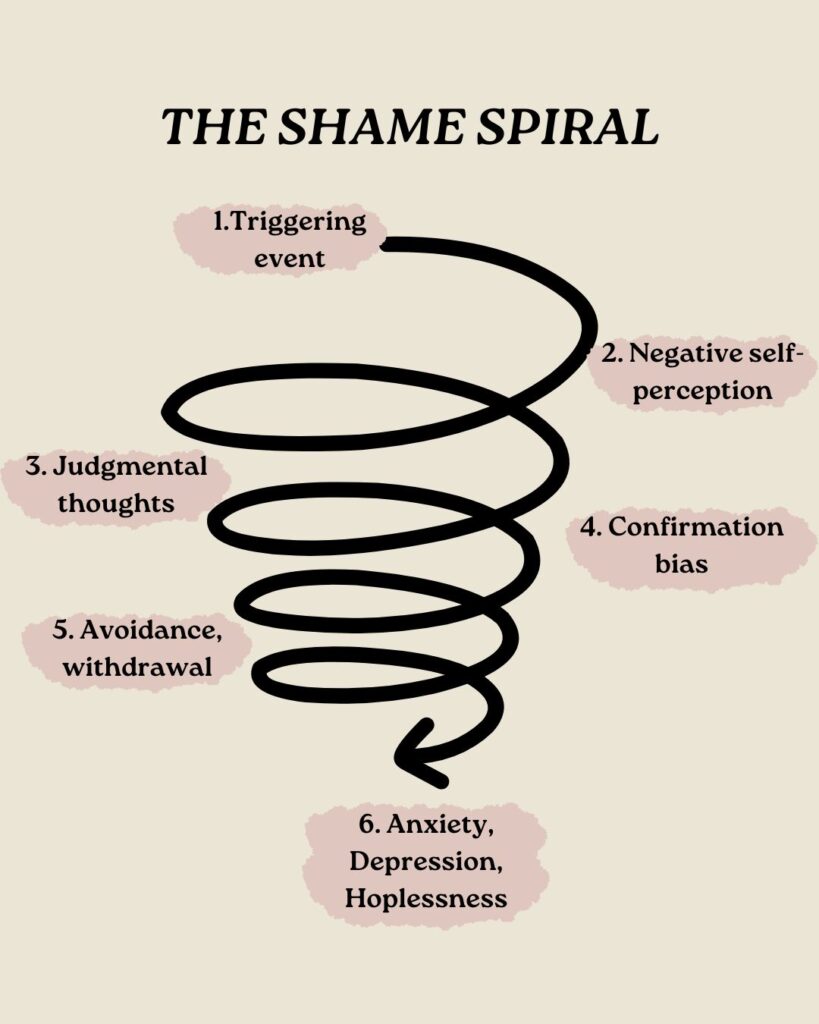
Depression doesn’t happen all at once. For many people, it develops through a repeating cycle of distress, guilt, and shame. The Depression Shame Spiral is a pattern I’ve seen in hundreds of clients, and one I’ve lived through myself. Understanding this spiral helps practitioners recognize what a client may be struggling with beneath the surface.
The spiral looks like this:
1. Something Distressing Happens
A person loses their job, receives bad news, or experiences something triggering. Stress can come from anywhere such as work, health, relationships, finances, or even long-term uncertainty.
2. You Feel a Strong Emotional Reaction
Sadness, fear, anger, embarrassment, and frustration are all perfectly normal emotional responses. But many of us are taught to see these emotions as “bad,” “weak,” or “unacceptable.”
3. You Feel Guilty About Your Emotion
Your internal monolog says things like
- “I shouldn’t feel this way.”
- “I’m being overly-dramatic.”
- “Other people have it worse.”
- “I should be stronger.”
Instead of recognizing distress as a signal, the brain treats it like a personal failure.
4. Guilt Turns Into Shame
Shame says:
“If I feel this way, I must be a bad person.”
This message is powerful and destructive. Shame attacks identity, not behavior. It convinces people that they don’t deserve help.
5. You Shut Down
The emotions become overwhelming. You withdraw, stop doing things you enjoy, avoid responsibilities, or feel paralyzed by small tasks.
This is often the point where Depression takes hold.
6. The Shutdown Causes More Shame
Now the brain says:
- “I’m letting everyone down.”
- “I’m failing again.”
- “I can’t even do normal things.”
- “People would be better off without me.”
This reinforces the spiral, pulling you deeper into Depression.
When someone is stuck in the shame spiral, asking for help feels impossible. Shame tells them they are the problem, not the distress.
Why Understanding the Spiral Matters for Practitioners
Clients may not say they’re depressed. Instead, they might:
- Miss appointments
- Struggle to follow through
- Hesitate to ask questions
- Apologize excessively
- Assume you’re angry or disappointed
- Downplay their own needs
- Seem “unmotivated” or “checked out”
These behaviors are not lack of effort; they are symptoms of the shame spiral. Understanding this cycle helps practitioners respond with empathy, not pressure.
Module 3 will introduce gentle ways you can help someone get out of their spiral and start making progress towards their goals.
Reflection Exercise: Lou
Take a moment to pause and consider the scenario below. You can reflect quietly, jot down notes, or skip this section if now isn’t the right time.
Lou is a man in his 50s with a strong background in auditing and project management. After two years of unemployment, he finally began receiving job offers but kept turning them down. When asked why, he stated:
“I think they made a mistake. I don’t see why they’d hire me.”
- What might Lou’s response suggest about how he views himself at this point in his job search?
- What past experiences or patterns could have contributed to this level of self-doubt?
- From a non-clinical perspective, what kinds of support or responses might help interrupt this cycle without pushing or minimizing his experience?
This reflection is meant to explore how shame and self-doubt can shape behavior, even when external opportunities are present.
Remember to notice what you’re thinking and learning. Take a break if you need one.
When you’re ready, continue to What is Anxiety?
 Disability and Mental Distress